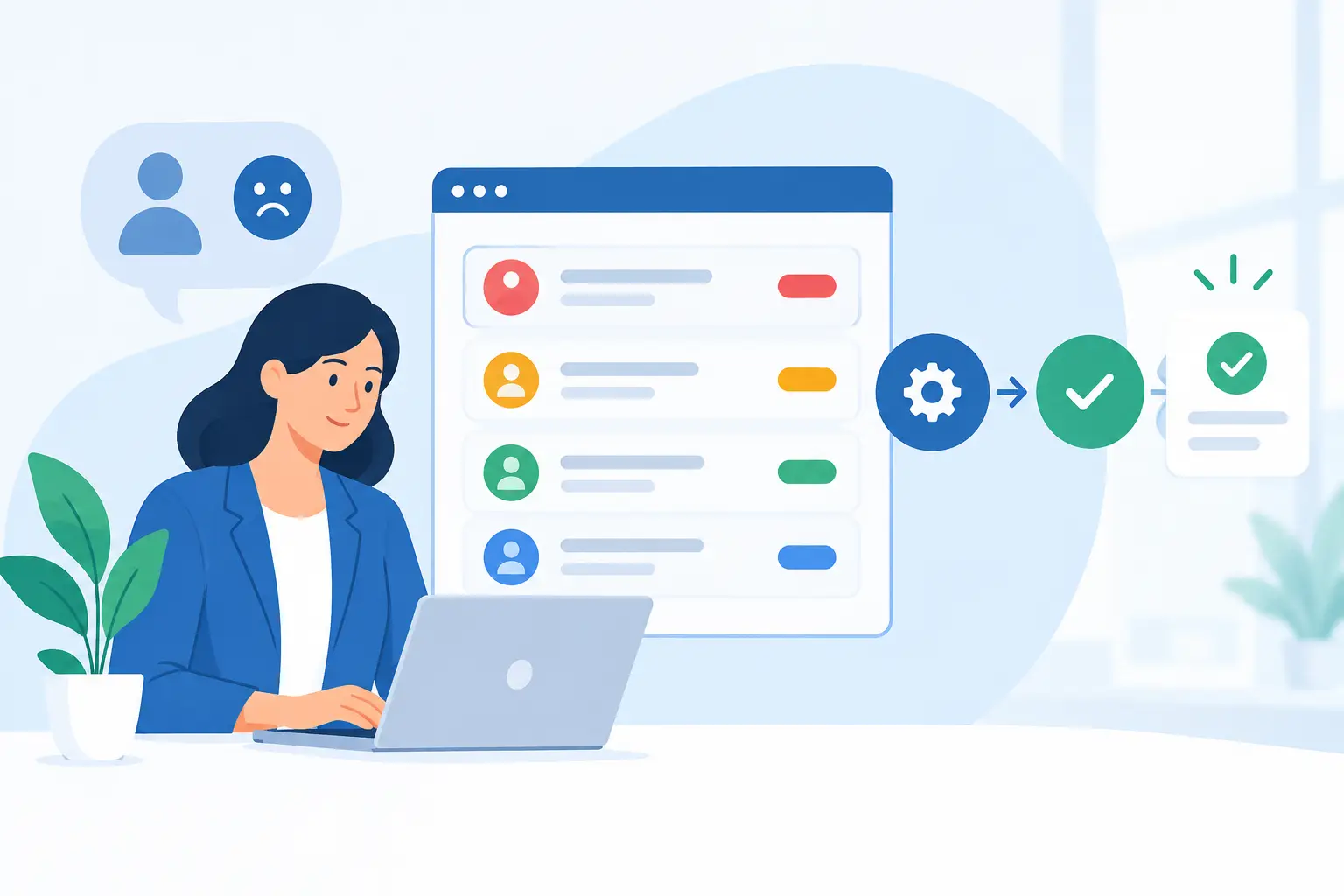
A complaint arrives as an email to service. Another appears in a CRM case. A third is buried in a work-order note, while a related issue surfaces in open-ended survey responses. Each record may be handled individually, yet the organization still misses the pattern. Complaint management software exists to turn those disconnected signals into an organized operating process - one that identifies recurring issues, assigns ownership, and tracks whether corrective action worked.
For teams responsible for customer experience, operations, service delivery, or employee feedback, the goal is not simply to close complaints faster. It is to understand what complaints reveal about a process, product, policy, location, or communication gap before the same problem creates avoidable cost and churn.
What complaint management software should do
At a basic level, complaint management software records cases, captures supporting details, and provides status tracking. Those functions matter, particularly where response deadlines, regulatory requirements, or service-level commitments apply. But a case-management view alone has a limitation: it can show that a complaint was resolved without showing whether the underlying issue is growing.
A stronger system connects individual complaint handling to feedback intelligence. It should ingest complaints from the systems people already use, including shared inboxes, survey platforms, CRM records, work-order tools, and customer-experience databases. From there, it should organize structured fields and unstructured text in one place, making the data usable without asking teams to manually prepare spreadsheets every week.
The practical test is simple: can a service leader move from a queue of individual cases to a clear answer about the issues driving volume, dissatisfaction, repeat contacts, and operational rework? If not, the organization has a tracking tool, not a complete complaint-management capability.
The difference between case closure and root-cause management
A closed case measures responsiveness. Root-cause management measures learning. Both are necessary, but they answer different questions.
Consider a customer who complains about a delayed installation. The service team may apologize, reschedule, and close the record. That is appropriate case handling. Yet if delayed installations are appearing across emails, survey comments, cancellation reasons, and technician notes, the operational problem may involve scheduling capacity, dispatch rules, parts availability, expectation setting, or contractor performance.
Without classification and cross-source analysis, each team sees only its own portion of the issue. Support sees complaints. Operations sees work orders. CX sees declining satisfaction. Leadership sees a retention risk after it has become expensive.
Complaint management software should make those connections visible. It needs consistent categories, the ability to preserve the original language of the complainant, and guided analysis that helps users test what is behind a trend. Automated classification can speed up this work, but it should not become a black box. Teams need to review categories, refine definitions, and understand why a record was grouped with others.
A connected workflow from intake to action
Effective complaint programs follow a repeatable lifecycle. The software should support that lifecycle rather than force teams to export data between separate tools.
Capture complaints where they already occur
Requiring customers or employees to use a new complaint form can create cleaner data, but it can also hide valuable feedback that arrives through normal channels. The better approach is to centralize existing sources while maintaining a consistent record structure.
Each complaint should retain key context: source, date, customer or respondent segment, location, product or service line, case status, severity, and associated operational data where available. The original text is equally important. A category such as “billing issue” is useful for reporting, but the written explanation often reveals whether the actual concern is an incorrect charge, confusing communication, a delayed adjustment, or a policy customers perceive as unfair.
Classify for operational decisions
Categories should reflect decisions the organization can make. Overly broad labels such as “service” or “other” produce dashboards that look tidy but offer little direction. Excessively detailed taxonomies create inconsistent coding and slow adoption.
The right level of detail depends on complaint volume, organizational complexity, and the actions available to the team. A multi-location service organization may need categories for appointment availability, arrival windows, technician conduct, first-time fix, and follow-up communication. A smaller B2B team may need a simpler structure based on implementation, account support, product usability, billing, and contract administration.
A root-cause-analysis library helps establish common definitions so that teams classify similar issues consistently over time. It also avoids rebuilding the same analysis every time a new manager asks why complaints are rising.
Analyze patterns across sources
Complaint counts are a starting point, not the final metric. A rise in complaints can indicate worsening performance, but it can also reflect increased customer volume, a change in reporting behavior, or a new intake channel. Teams need to compare counts with rates, segments, locations, issue types, sentiment, and related experience measures.
This is where bringing unstructured data together matters. A complaint trend becomes more credible when it aligns with survey comments, email themes, repeat contacts, or work-order notes. Conversely, a high-volume category may prove less urgent if it is resolved quickly and does not correlate with poor outcomes. The analysis should prioritize problems based on impact, recurrence, and the organization’s ability to intervene.
Turn findings into accountable work
Insight without a follow-through mechanism becomes another report. Once a recurring issue is identified, the team needs a place to define the action, assign an owner, set a due date, document the expected outcome, and monitor progress.
An Action Backlog creates that bridge between analysis and execution. For example, a complaint dashboard may show that missed appointment windows are concentrated in two service regions. The resulting actions could include reviewing capacity rules, updating customer notifications, and auditing dispatch exceptions. Each action should have an accountable owner and evidence that indicates whether it reduced the problem.
Not every complaint trend warrants a large project. Some issues need a policy clarification, a script update, or targeted coaching. Others require investment and cross-functional sponsorship. The workflow should make these trade-offs explicit rather than treating every finding as equally urgent.
What to evaluate when choosing a platform
Organizations often begin with the tools they already own. A CRM may provide case management, a help desk may manage tickets, and a survey platform may collect complaints through open-ended questions. Those tools can be sufficient when complaint volumes are low, sources are limited, and analysis is straightforward.
The need for a dedicated feedback intelligence platform grows when information is fragmented and teams cannot reliably connect case-level records to enterprise trends. During evaluation, look beyond intake forms and status fields.
A useful platform should support data-source integrations, text analysis, configurable classifications, complaint dashboards, root-cause workflows, role-based access, and action tracking. It should also allow technical and nontechnical users to work from the same evidence. Analysts may need to inspect source text and refine categories, while executives need concise views of the issues, owners, and progress.
Governance deserves equal attention. Decide who owns taxonomy changes, how duplicate complaints are handled, what information is sensitive, and which teams can view respondent-level details. In regulated environments, retention and audit requirements may shape the implementation. A system that is easy to launch but unclear about ownership will gradually produce inconsistent data.
Metrics that show whether the process is working
Resolution time and closure rate are useful operational measures, but they are incomplete. A mature program monitors both case performance and improvement performance.
Case measures can include acknowledgment time, time to resolution, reopened cases, escalation rates, and complaint volume by source or segment. Improvement measures look at repeat complaint rates, prevalence of priority root causes, completion of corrective actions, changes in related satisfaction measures, and outcomes after an action is implemented.
Be careful with targets that encourage the wrong behavior. Pressuring teams to reduce complaint volume can lead to harder-to-use reporting channels or premature case closures. The better objective is to reduce preventable problems while making it easy for people to raise concerns. Fewer complaints are meaningful when related service, retention, and feedback indicators improve as well.
Make complaints a decision input, not a side process
Complaints are often the earliest detailed evidence that a process is failing for real people. They contain language, context, and urgency that a score alone cannot provide. Treating them as isolated service events leaves operational intelligence scattered across inboxes and systems.
StatQuestions brings complaint records, survey feedback, email intelligence, and operational notes into a shared environment for classification, Guided Analysis, dashboards, and accountable action. The value is not merely a cleaner complaint log. It is a repeatable way to move from messy feedback to decisions that teams can own and measure.
The most useful next step is not to create another report. Choose one recurring complaint theme, connect it to the related feedback and operational data, assign a specific action, and check the result. That is how a complaint process starts becoming an improvement system.